
Progressive Rock
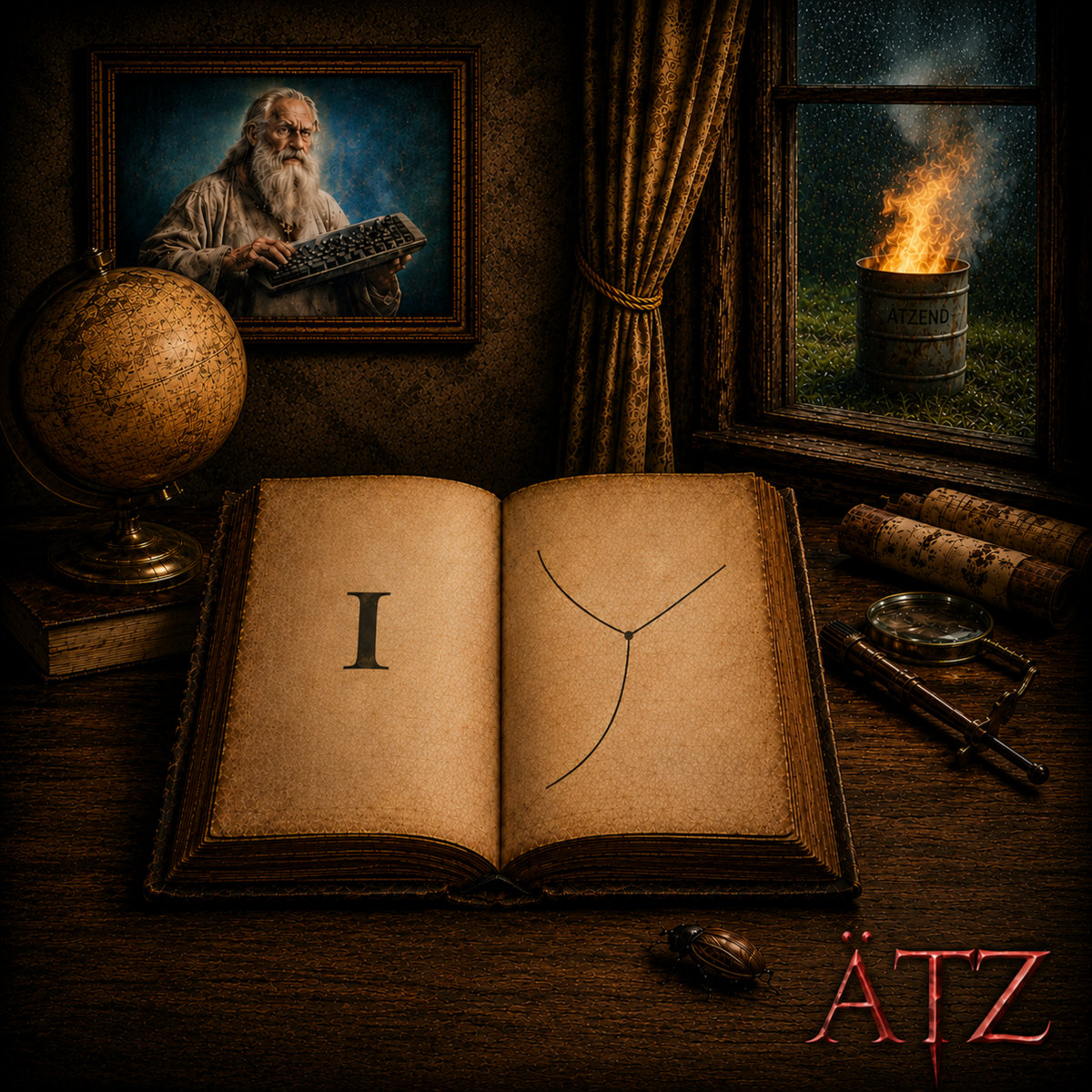
Self-released · 20 June 2026
The last track on the album runs twenty-five minutes and fourteen seconds and splits into three dances. “Suite Panoramica” begins instrumental, with “Danza degli zoppi”, over a rhythmic figure that limps on purpose: the groove is there, but it never quite lands where the ear expects it. On “Danza degli insetti” the voice comes in and the movement closes into a circle, over a lyric watching a humanity walking in single file (“Tu vedi una prigione / Ma le sbarre sono le mie strade”), and “Danza del mentre” pushes the tempo forward while the text stays fixed on a screen.
ÄTZ is Giuseppe Atzori, a multi-instrumentalist from Cagliari, and “LIBRO I: dei deliri e delle profezie” is the first volume of a series. He did all of it himself: electric and acoustic guitars, bass, keyboards, vocals, virtual instruments and programming, plus the writing, the arrangements, the recording, the mix and the master, at home, across 2024 and 2025. Six tracks and sixty-two minutes, out on 20 June, and a month later, on 19 July, the second volume was already there: “LIBRO II: delle nostalgie e delle tifoserie”, also six tracks.
“Oracolo” opens with eight and a half minutes that concede nothing on the way in, and the lyric addresses a digital oracle with the crowd chanting “Spettacolo! Miracolo!” at it. “Punto Triplo” is five instrumental minutes built as a dialogue between guitar and keyboards, with thermodynamics’ triple point as the pretext and an intensity that recalls Camel. “Droste” climbs in layers, like the engraving it is named after, and “Mappamondo” opens up the album’s acoustic register.
The part that does not keep up is the foundation. All the percussion and much of the low end are programmed virtual instruments, and that tells precisely where the album stakes the most: the asymmetric figures of the closing suite are always exactly identical, repeated with a precision no real drummer would have and no rhythm built to limp actually wants. There is a second debatable decision in the package, and it is the author’s: the cover was made with generative AI tools, selected and edited by him, on a record whose lyrics take aim at copy-and-paste thinking. The Bandcamp credits say so.
Rating: 7.4/10
Text by Guillem Cardós