
In my book “Los Instrumentos Musicales del Rock Progresivo; Guía Ilustrada”, of which this article series are short extracts, the content is organised into sections (keyboards, guitars and basses, drums and percussion, others…) in a roughly chronological order, with the aim of tracing various aspects of Progressive Rock history alongside the history of its instruments, both running in parallel. But for these standalone articles for the Tòtum Revolútum website, which will be published bit by bit, I think it’s better to alternate content and mix things up a little, covering different kinds of instruments and not necessarily in any fixed order.
So, having already dedicated the previous 3 articles to keyboard instruments, today’s article is dedicated to a unique instrument every classic Prog fan will have seen: the triple-neck bass made famous by Chris Squire of Yes.
The story of this impressive instrument begins in 1974, when Rick Wakeman was preparing his solo album “The Myths and Legends of King Arthur and the Knights of the Round Table”, released in 1975. Symphonic Rock was at its peak, and the leading bands seemed locked in a race to see who could go the biggest. Songs kept getting longer and more complex, thematic concepts more abstract and intricate, tours more lavish and spectacular… nothing seemed excessive.
For the studio recording, his bassist at the time, Roger Newell, a member of the English Rock Ensemble that backed Wakeman during that period, used ordinary basses (mostly Rickenbacker), but for the tour that would follow the album, Wakeman wanted something spectacular that would top everything seen up to that point. Double-neck instruments had already become popular, so he thought of a triple-neck bass. Wakeman would pay for the instrument, and Roger Newell would play it.

Roger Newell with the Wal triple-neck in 1975
Newell knew luthiers Ian Waller and Pete Stevens, who up to that point had only built one professional-grade bass, for Caravan bassist John G. Perry — the so-called Wal model W1111 — and he passed on Wakeman’s commission to them despite their limited experience. The three of them (Newell, Waller and Stevens) got to work designing the instrument and settling on all its specifications.
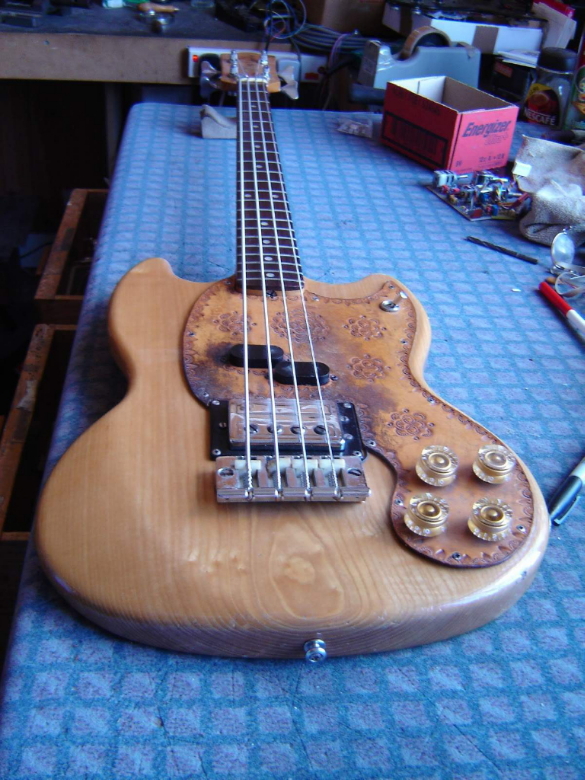
The Wal W1111 built for John G. Perry. Note the exclusive detail of the pickguard, made of hand-engraved leather
Initially they considered a genuine triple-neck bass, with a fretted 4-string bass (standard EADG tuning), a fretless 4-string bass but with fingerboard lines marking the positions (to be tuned DGCF specifically for the song “Merlin the Magician”), and an 8-string bass arranged in 4 pairs — but they realised the instrument would be too heavy, and decided to swap the 8-string bass neck for a regular 6-string guitar neck, Fender Telecaster-style, which was much lighter. At the time, although Jaco Pastorius of Weather Report had already started playing his defretted Fender Jazz, fretless basses were still highly unusual, and Newell had never played one before — he had to learn and practise the technique, which is why he wanted the fingerboard to have lines marking where the frets would have been.
The guitar neck was placed at the top, the fretted bass neck in the middle, and the fretless one at the bottom. The bass pickups were modified Fender Mustang units, the guitar pickups were standard Fender Telecaster ones, the bridges were also Fender, the tuning pegs were Schaller, and one singular feature was the enormous pickguard made of hand-engraved leather, which Waller and Stevens had already used on the W1111. Curiously, it was never given any specific model name, so it’s simply known as “the Wal triple-neck”. This colossal instrument was without doubt a spectacular sight on that Wakeman tour.
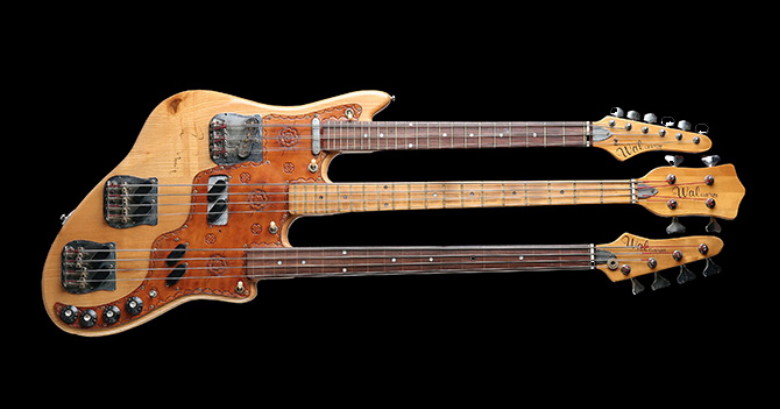
The Wal triple-neck. Here we see it after the modification Squire made to the guitar neck, replacing the 6 regular strings with 3 paired courses
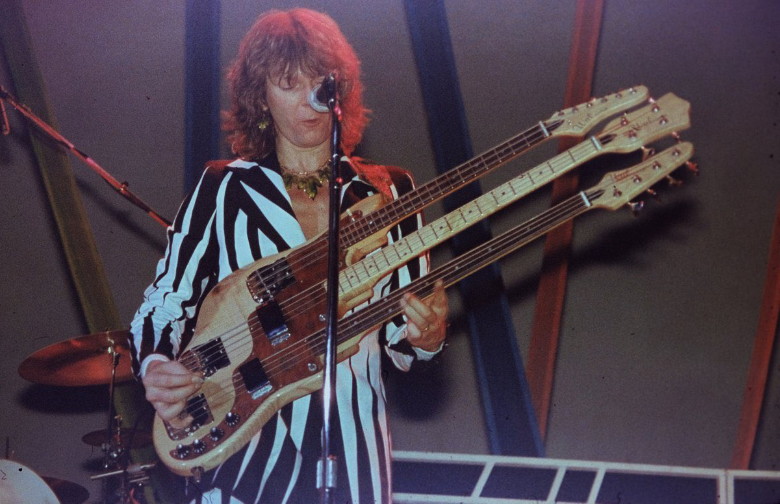
Squire playing the Wal triple-neck in 1977
Wakeman rejoined Yes in November 1976 and offered to sell the instrument to Newell, but the triple-neck had become famous by then and was valued at a price far higher than it had cost to build — one Newell couldn’t afford — so Wakeman kept the instrument, which didn’t sit well with Newell at all, since he felt he should in some sense be considered a co-owner, having designed and helped bring it to life together with Waller and Stevens.
When Yes were preparing the tour for their 1977 album “Going for the One”, Wakeman thought the Wal might suit Chris Squire for playing the long track “Awaken”, which called for a great deal of tonal versatility. Squire agreed immediately, adjusted the tuning for the song, and before long, at the Yes shows on that tour, the Wal triple-neck became the star instrument whenever they played “Awaken”. Squire also changed the configuration of the top guitar neck, fitting it with 3 paired courses of strings (tuned ADG), the same way 12-string guitars or 8-string basses arrange their strings in 4 paired courses, each pair tuned an octave apart.
When Wakeman left the band again in early 1980, the Wal had already become an icon associated with Chris Squire playing “Awaken”, and Rick decided to give him the instrument so he could keep using it with Yes.
The original Wal was very heavy and, technically speaking, wasn’t anything special, and once the “Union” tour wrapped up in 1992, Squire decided to replace it. In Japan there was a luthier named Hiroshi Kid who had built 2 replicas of the Wal, lighter and technically more modern, and Squire bought one of them from him (Kid kept the other one, after asking Squire to sign it). Squire went on using the Japanese replica and donated the original Wal to Hard Rock Cafe, who kept it at their New York location for a long time, though I believe more recently they’ve been rotating it around several of their venues.

Three of Chris Squire’s iconic basses: the Wal triple-neck, the Rickenbacker 4001 (strictly speaking, an RM 1999) and the Mouradian CS74
Wal went on building basses and earned themselves an excellent reputation, and their instruments have been used by famous bassists such as John Entwistle of The Who, Percy Jones of Brand X, Geddy Lee of Rush, or more recently Colin Edwin of Porcupine Tree.

Geddy Lee with a Wal Mk I in 1988
Until next time!
Gerard Bassols
If you enjoy this topic, remember you’ll find much more information in the book “Los Instrumentos Musicales del Rock Progresivo; Guía Ilustrada”, available at this link. And if you need to start thinking about Christmas or Epiphany presents, now you know!
https://www.amazon.es/instrumentos-musicales-Rock-Progresivo-ilustrada/dp/8413318645
And if you’d prefer, it’s also published in English:
https://www.amazon.com/Musical-Instruments-Progressive-Rock/dp/8413385997