
Today I’ll talk about another unique instrument that also became iconic of the golden age of Symphonic Rock: Carl Palmer’s stainless steel drum kit, of Emerson, Lake & Palmer (ELP).
In the first half of the ’70s, Symphonic Rock was in full swing — the leading bands sold huge numbers of records and filled massive venues on their tours. There seemed to be an unwritten rule that said “the more, the better”, with nothing ever considered excessive. The music kept growing more complex and elaborate, the thematic concepts more abstract and ambitious, the album covers more sophisticated and expensive to produce, the tours more lavish and spectacular in terms of staging, sound and lighting, and the musical instruments themselves also grew increasingly sophisticated and spectacular.

Palmer with the stainless steel drum kit in 1973
ELP in particular stood out especially in this race. Despite only debuting in 1970, their progress was extremely fast. By late 1972/early ’73, Keith Emerson had already expanded his Moog modular synthesizer to a scale never seen before, and on top of that he carried the 2 Hammond organs (C-3 and L-100), a Hohner Clavinet, a Minimoog and an acoustic piano. Greg Lake played his various basses and guitars while standing on a £6,000 Persian rug, and had commissioned luthier Tony Zemaitis to build him an exclusive double-neck guitar/bass. And Carl Palmer, after starting out with a simple Ludwig kit of just 1 rack tom and 2 floor toms, had also expanded his kit considerably and was playing a Ludwig Octaplus with 7 toms + 2 floor toms, alternating black and gold-finished drums, already complemented by the two huge Paiste gongs and a 60kg church bell he’d acquired from a foundry that had rejected it for being slightly out of tune.

Palmer’s Ludwig Octaplus kit in late 1972, already quite complete
Emerson and Palmer were named, respectively, best keyboardist and best drummer in the world (in the rock genre) at Melody Maker magazine’s 1972 awards, and ELP were named best band in the world (with Lake as best producer, and Emerson/Lake as best songwriters — ELP swept the board that year, no doubt about it). Those awards were celebrated with a concert on 30 September ’72, at which ELP brought along 2 enormous Tarkus figures that puffed smoke from their mouths and fired foam from their cannons.
Swept up in the excitement of the moment, the band set up their own record label, Manticore Records, and bought a theatre in Fulham, London, to use as a rehearsal space and recording/production studio (Manticore Studios), through which bands like Led Zeppelin, Jethro Tull and Premiata Forneria Marconi passed, whether to record or to rehearse for their tours. There they began work on what many consider their most ambitious album, “Brain Salad Surgery”, released in late 1973.
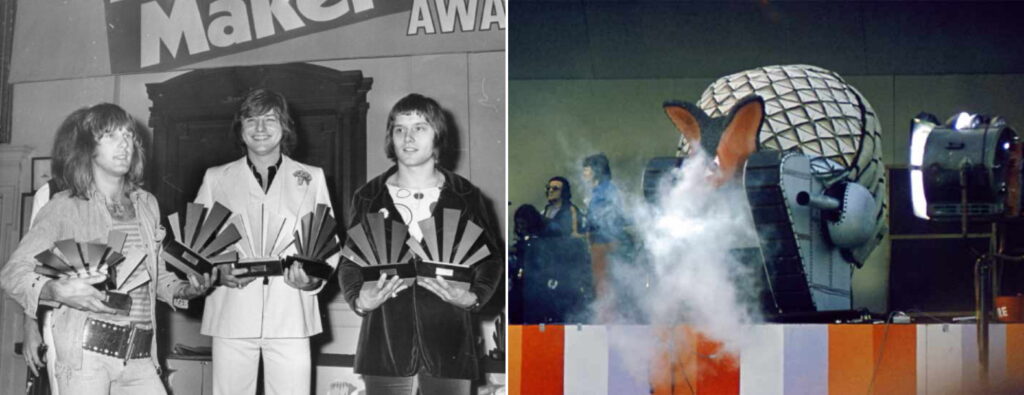
ELP collecting their Melody Maker awards in 1972, and one of the Tarkus figures

An early prototype of the stainless steel drum kit. Later on, the toms were split into 2 groups to make room in the middle for the ride cymbal, and mounts were added for more elements and for the tom microphones
ELP were on fire, and Palmer needed something even more unique and spectacular. It’s not entirely clear whose idea it originally was, but what’s certain is that Palmer and the steel company The British Steel Company, which sponsored the project, began working on the design of an exclusive drum kit made of stainless steel. Up to that point, drum shells (the cylindrical bodies of the bass drum, toms and floor toms) were made of wood, with some made of fibreglass or plastic. Only the snare shell was often made of metal, though wooden snares also exist.
It might seem curious that no drum manufacturer was involved in the project, not even Ludwig, Palmer’s main supplier at the time, but Palmer explained that this was because manufacturers wanted to approach it commercially, whereas he wanted something unique, personal and exclusive. So the whole thing was worked out between Palmer and British Steel’s engineers, plus an electronics engineer named Nick Rose for the electronic side, which I’ll get to shortly. The only components from other manufacturers used were the hoops, which were Gretsch, the snare, which was a Ludwig, and the bass drum pedal and hi-hat stand, also Ludwig (with Remo heads and all-Paiste cymbals).
Drum rack systems didn’t exist yet at the time — the first commercial one was released by Pearl in 1983. Drum racks are structures made of tubing or profiles onto which the various parts of a drum kit can be mounted, mainly toms and cymbals, but also other percussion elements. Up until then, every tom or cymbal needed its own individual stand (unless mounted directly on the bass drum), so for a large kit like Palmer’s, the process of setting everything up and adjusting the position of each element was extremely long and laborious.
This kit would solve that problem by building a steel structure with fixed mounts for every element — toms, cymbals and some percussion pieces — so nothing needed adjusting each time it was set up. An innovative idea at the time, though it created difficulties for transport, since the structure was very large and heavy and didn’t fold down or dismantle like modern racks (it was only split into 2 parts, one on each side). But at that point ELP weren’t thinking about costs or practical problems. The rack also included mounts for the microphones placed inside each tom — there were two per tom, one regular acoustic mic and another to trigger the electronic sounds.
The shells for the bass drum, toms and floor toms were built from quarter-inch-thick stainless steel sheet (some sources, including Palmer himself in some interviews, say half an inch, but the current owner has confirmed the correct figure is a quarter of an inch). It consisted of 7 toms ranging from 6 to 15 inches in diameter, 2 floor toms of 16 and 18 inches, and an enormous 28-inch bass drum (compared to the more common 22-inch size). As mentioned, the snare was a 14-inch Ludwig, the bass drum pedal a Ludwig Speedking, and the hi-hat stand also a Ludwig Atlas. The stool was also custom-made for Palmer. All the toms were single-headed (so-called concert toms), meaning the microphones were placed underneath, inside the shells.
To make it even more unique and spectacular, Palmer commissioned jeweller Paul Raven to engrave animal images onto every piece, and he also decorated the back of the gongs with images of Chinese dragons.
According to Palmer, the steel produced a very powerful, bright sound compared to traditional wood.
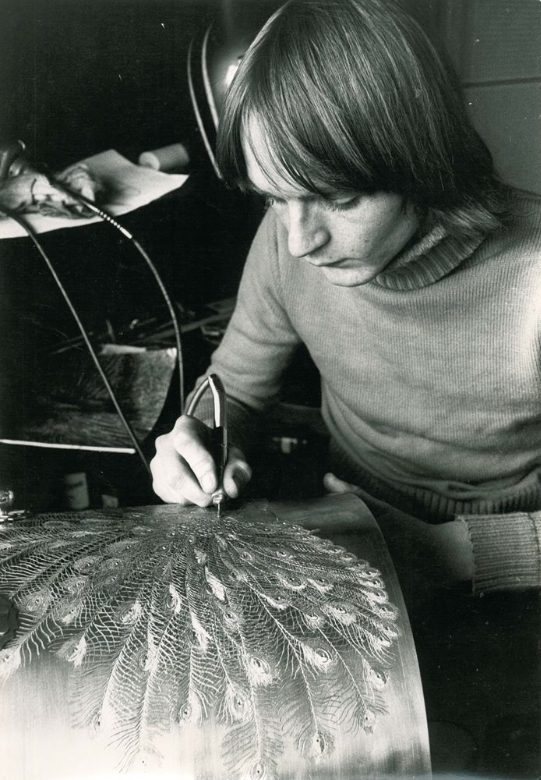
Paul Raven engraving the stainless steel shells
Another innovation was the addition of electronics. While there had been some earlier experiments, like Moog’s trigger drum, the first commercial electronic percussion units didn’t appear until 1977 (the Pollard Syndrum), and the first electronic drum kit came in 1980 (the Simmons SDS-5). What Palmer and company did was fit the acoustic toms with a second microphone that triggered a small synthesizer producing a pre-programmed sound. Given the close collaboration between Bob Moog (father of the modern synthesizer) and Keith Emerson at that time, you might assume Moog built these, but that wasn’t the case.
Moog did in fact build a very basic first prototype for Palmer, but was too busy with other work, and Palmer turned to a young engineer named Nick Rose, who built the special microphones and the mini-synthesizers. There were 8 of them (3 that played sequenced patterns, and 5 that played single sounds), switched on and off with a foot pedal at the drum kit. Palmer used them to generate electronic sounds during his solo on “Toccata”, which became a regular feature of ELP concerts. That’s why, even though the kit itself was acoustic, Palmer liked to say it was the first electronic drum kit in history — and in that sense, he had a point.
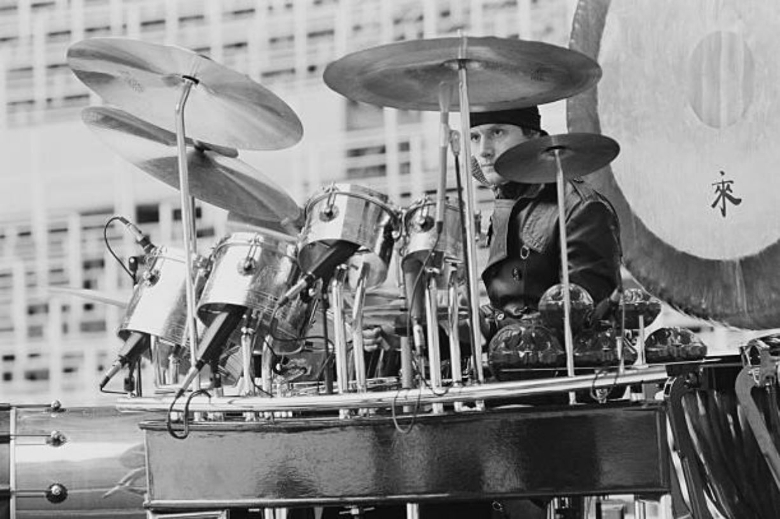
In this photo you can make out the acoustic mics inside each tom, and how each one also had a second steel tube running inside it, housing the small microphone that triggered the corresponding synthesizer. In the foreground you can also see the set of 5 temple blocks
The kit itself was complemented by an upper structure holding the 2 huge Paiste gongs, 38 and 50 inches, the church bell (which Palmer famously played by pulling the rope with his teeth), a giant triangle and some other percussion. Palmer also had a pair of orchestral timpani (26 and 29-inch Ludwigs) and a one-and-a-half-octave set of Ludwig tubular bells. The whole thing sat on an equally innovative rotating podium (turned manually by roadies).
All told, the whole setup weighed 2.5 tonnes, and several stages had to be reinforced to bear the weight; some concerts had to be cancelled when that wasn’t possible.
Palmer debuted the spectacular kit in 1973 and, though he made a few changes to it over the years, kept using it until ELP disbanded in 1979.
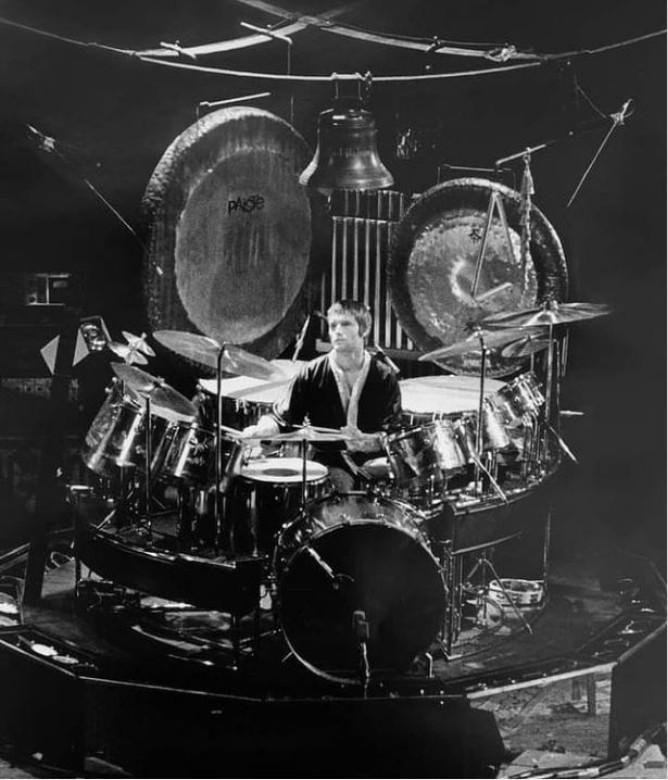
Palmer playing the kit in 1974
As a curious aside, on that 1973–’74 tour Emerson also debuted another eccentricity: a piano that rose several metres above the stage and spun around while he played it. He used it only a few times because setting it up was complicated and there was a real risk of injury (one of those times was at the legendary California Jam festival-concert on 6 April ’74, where ELP co-headlined with Deep Purple, with bands like Black Sabbath, the Eagles, Rare Earth and others also performing, and which drew a crowd of 250,000 people). The piano wasn’t actually real — the music was pre-recorded — but it’s yet another example of ELP’s mindset at the time, always chasing spectacle, where nothing was considered excessive or ridiculous. That same mindset showed up again with the tour’s triple-LP live album, “Welcome Back My Friends to the Show That Never Ends”, made to rival the also-triple “Yessongs” that Yes had released the year before.
Incidentally, Emerson wasn’t the first to pull off the levitating, rotating piano trick — if you search YouTube for “The Steve Allen Show – Levitating Rotating Grand Piano Gag”, you’ll see this entertainer had already done it back in 1959.
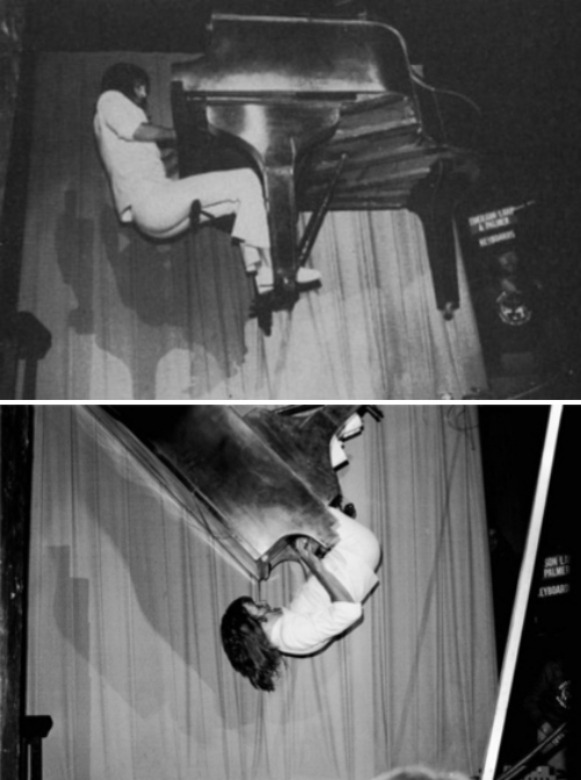
Keith Emerson with his levitating, rotating piano
After that tour, ELP went more than 2 years without setting foot on stage, and it wasn’t until March 1977 that they released their new studio album, “Works Volume 1”, with which they launched their next ambitious vision: a massive tour of almost 100 concerts (nearly all in the USA and Canada) with a 64-member symphony orchestra (58 musicians plus a 6-person choir) and an impressive technical production, geared mainly towards playing in large open-air stadiums or big venues.
Some figures: the sound system alone cost them $1 million (it was the same rig used for the 1976 Montreal Olympics, rated at 72,000 watts RMS), on top of which came all the equipment needed to amplify and monitor the orchestra. 40 enormous speaker cabinets, each containing 10 JBL drivers and weighing 200kg apiece. The orchestra was placed on large elevated risers which, like the main stage, had to be built from aluminium to avoid excess weight. The rigged equipment (part of the speaker system and a lighting rig of almost 400 fixtures) weighed more than 4 tonnes. The total crew that had to travel from show to show numbered 115 people, with their corresponding accommodation and per diems. They had 63 roadies (some hired locally for each show), and even so, setup took 8 hours, and teardown another 4. Everything was transported in a fleet of between 8 and 12 trailers plus 3 coaches…
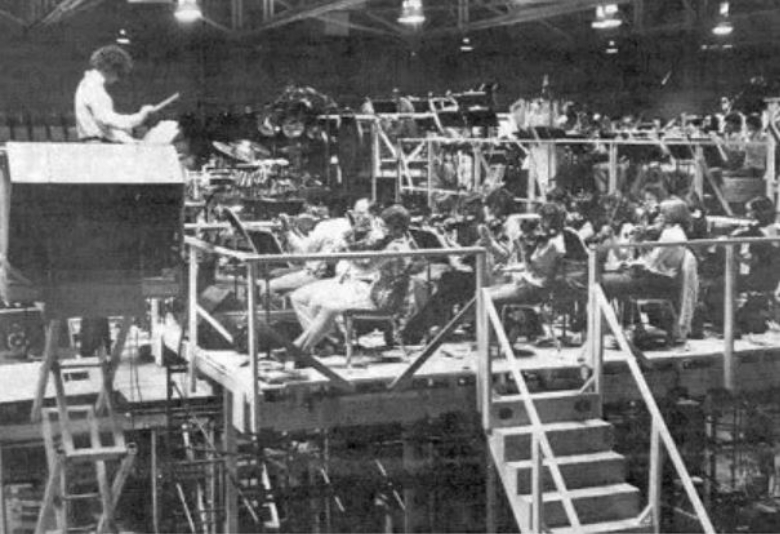
The risers for the orchestra; note that conductor Godfrey Salmon stood on a hydraulically raised platform
Besides the kit with its usual percussion (gongs, orchestral timpani, tubular bells, temple blocks, crotales…), Palmer also brought along a vibraphone, a glockenspiel (metal xylophone) and a set of congas. Emerson and Lake’s instrumental rig was no less impressive — probably the most special instrument at the time was Emerson’s Yamaha GX-1 synthesizer, which cost $60,000 in the money of the day (besides his usual “monster Moog”, the Hammond C-3 and L-100 organs, a specially split Minimoog built just for him, the Steinway grand piano and the accordion). Greg Lake carried 4- and 8-string Alembic basses, Martin acoustic guitars, a 12-string Zemaitis, and a fairly exclusive electric Travis Bean with an aluminium neck.

ELP with the orchestra in May 1977, in Detroit
All told, the fixed up-front costs of the tour came to over $2 million, plus a weekly running budget of $200,000. Looking back today, it probably seems unbelievable that the accountants, financiers and managers weren’t able to put together an accurate projection of what this project would mean financially. They must have been every bit as optimistic as ELP themselves, who were still living out their dream that their grandeur would know no limits.
The truth is, between all of them, they messed it up. While the audience response was strong enough, just a handful of shows in, the accountants told them the numbers didn’t add up, and on top of that “Works Volume 1” wasn’t selling as well as hoped. The project suddenly had to be pulled. Only 15 shows were played with the orchestra, and the rest had to continue as a trio, with the setlist adapted accordingly, but many of the overhead costs couldn’t be avoided, and the whole affair left them practically bankrupt. Fortunately the audience took the situation reasonably well, because if everyone who’d bought a ticket to see an ELP concert with orchestra had demanded a refund for the promise not being kept, ELP would have faced far more serious problems still.

Palmer playing the bell with his teeth during his solo
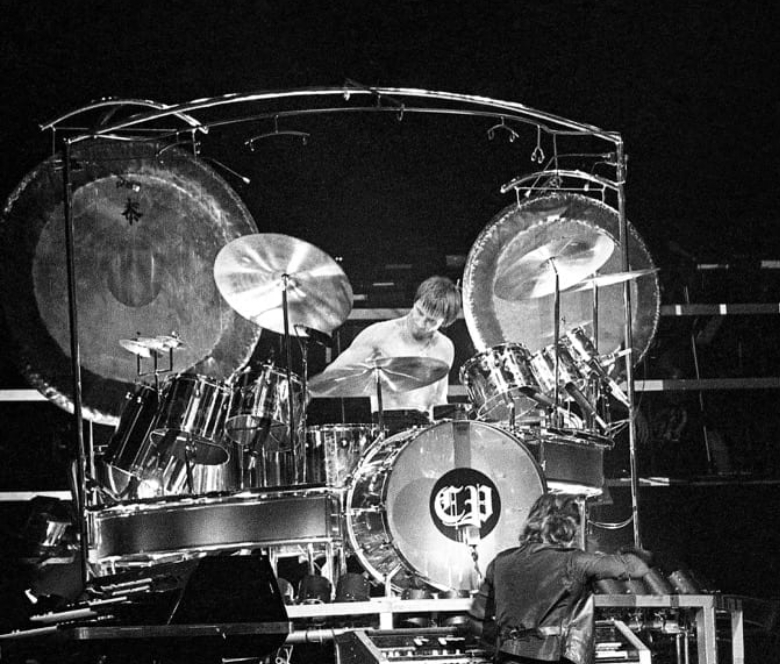
The kit in 1977; the upper structure had changed, and it no longer carried the bell
After ELP disbanded, Palmer sold the kit to Ringo Starr, who wanted it for his son Zak, but Zak never actually used it, and the kit sat in storage until 2015, when Ringo decided to put it up for auction along with many other drum kits and gear he owned. Modern Drummer magazine editor David Frangioni, a drum enthusiast, bought it for $75,000 and would like to see it displayed at the Rock and Roll Hall of Fame museum in Cleveland, Ohio, though he hasn’t managed that so far (the museum has often been criticised by Progressive Rock fans for the lack of representation the genre gets in its collection).
This kit, then, was truly iconic, and beyond its sheer size it was innovative in at least 4 respects: the material it was made from, the fact it was a precursor to modern rack systems, its use of electronics, and the fact it was the first kit mounted on a rotating podium. Without doubt, one of the enduring symbols of ’70s Prog’s extravagance and excess, an era when things were often pushed to the very limit.
In 1976, John Bonham of Led Zeppelin asked Ludwig to build him a stainless steel kit as well, which he used from ’77 until the end of his career. Ludwig then released a commercial stainless steel line, but the kits were very expensive and heavy, failed to sell, and were discontinued in 1980. In 2006, though, they released a small reissue run of Bonham’s kit, aimed more at collectors and fanatics, priced at £7,000.
By the 2000s, with his Carl Palmer Band, Palmer had another metal kit, this time made of a bronze alloy similar to the one used for cymbals. It was actually a project by Jeff Ocheltree, who proposed to Paiste (one of the biggest cymbal manufacturers) that they also build drum kits using the leftover alloy from cymbal manufacturing. The project, however, was a failure: Paiste supplied leftover alloy from their successful 2002 cymbal series, but the drum shells made from it kept cracking, and they had to keep trying different alloys and add more virgin, higher-grade metal; they eventually realised the idea of using leftover material simply didn’t work, and manufacturing new, suitable alloys from scratch would be too expensive.
In the end, only 3 complete kits were ever built: Palmer’s, one for Danny Carey of Tool, and a third that stayed at the offices of manufacturer Duluth Brass Manufacturing in Minnesota, USA. Palmer’s bass drum heads read “Paiste” as the manufacturer, even though Paiste never officially took part in building it beyond supplying some of the metals used.

Palmer playing his bronze-alloy “Paiste kit”
Until next time!
Gerard Bassols
If you enjoy this topic, remember you’ll find much more information in the book “Los Instrumentos Musicales del Rock Progresivo; Guía Ilustrada”, available at this link. Have you read the readers’ reviews yet?
https://www.amazon.es/instrumentos-musicales-Rock-Progresivo-ilustrada/dp/8413318645
And if you’d prefer, it’s also published in English:
https://www.amazon.com/Musical-Instruments-Progressive-Rock/dp/8413385997