
Today I’ll talk about Fender’s electric basses, instruments that have been just as enormously successful as their guitars, and of course also widely used in Progressive Rock throughout every era.
American Leo Fender is usually considered the father of the modern electric bass — that is, a compact, solid-body electric bass with a fretted neck, designed to be played hanging from a strap in the same position as a guitar. That was his Precision Bass model, launched in 1951, a year after his first guitar, the Esquire, which was very soon renamed the Telecaster (his first production instrument had actually been the Champion electric lap steel guitar from 1949. Lap steel guitars are played flat and horizontal, using the technique known as “slide”, and originated in Hawaii in the late 19th century).
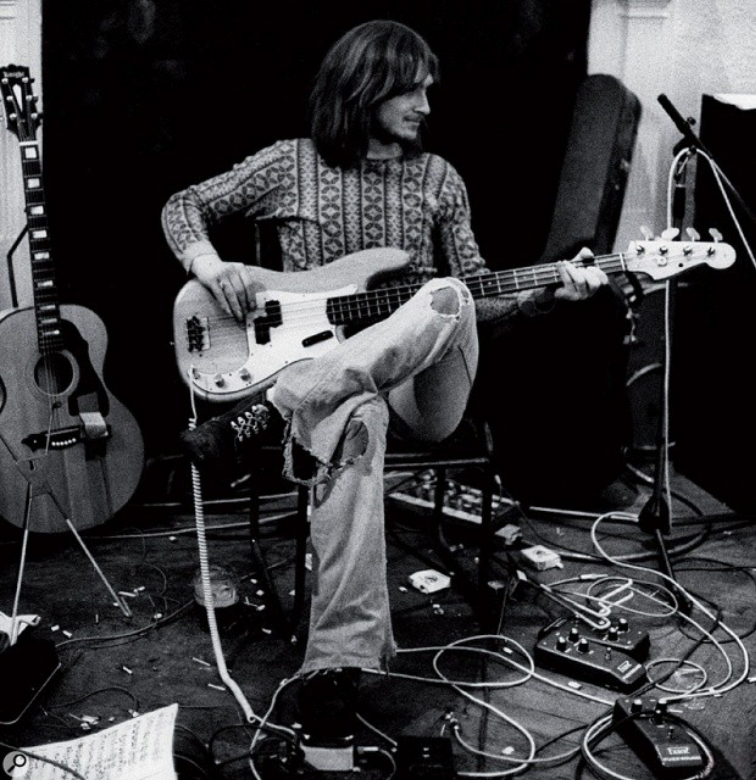
Mike Oldfield playing a Fender Precision. It’s missing the pickup cover, so we can see it’s the split-design pickup, in 2 segments, introduced in 1957
Before this, bassists had to play either the traditional double bass, or some slightly smaller variants that had emerged known as bass-viols, some of them already electrified from the mid-to-late ’30s. These instruments, though, were very large and hard to transport, were played upright, and had no frets, and it was often hard for them to be heard clearly over louder instruments like the new electrified guitars, the electric organs that were also becoming popular, drums, and even some wind instruments.
But crediting Leo Fender as the inventor of the modern electric bass isn’t entirely fair, since there was an earlier, if little-known, precedent: the Audiovox Model 736 Bass Fiddle from 1936, built by a man named Paul H. Tutmarc in Seattle, USA. This, however, was basically handcrafted in small quantities and had very little reach. We don’t know whether Leo Fender ever came across this instrument and drew inspiration from it; what’s certain is that the Fender Precision (known for short as the “P-bass”) was the first one designed for mass production and sold on a large commercial scale, and it was a true revolution.

The Audiovox Model 736 Bass Fiddle (here with its dedicated 936 amplifier) was the first modern electric bass, beating the Fender Precision to it by 15 years
It was given the name “Precision” because having frets on the neck meant the notes always sounded at the correct, precise frequency, unlike on fretless double basses, where it’s the exact position of the finger that determines the note played, and you have to be precise for every note to come out in tune. The fretted neck also made it much easier for guitarists to pick up and play.
The first 1951 Precision resembled the Esquire/Telecaster guitar — its body contours were still almost straight-edged, the headstock shape, also with all the tuning pegs lined up along the top, was very similar, it had a single single-coil pickup (like the first Esquire, though a 2-pickup version, which would become the well-known Telecaster, followed very soon after), and the volume and tone controls were mounted on a separate horizontal metal plate away from the pickguard.
A major innovation was its double-cutaway body, which Fender came up with because the bass neck was longer and heavier than a guitar’s, and without the upper horn, the neck end would tend to droop from the weight when worn on a strap. The upper horn allowed the strap to be fixed over the 12th fret, keeping the weight balanced, and this concept quickly spread to many other basses and guitars.

The first Precision from 1951
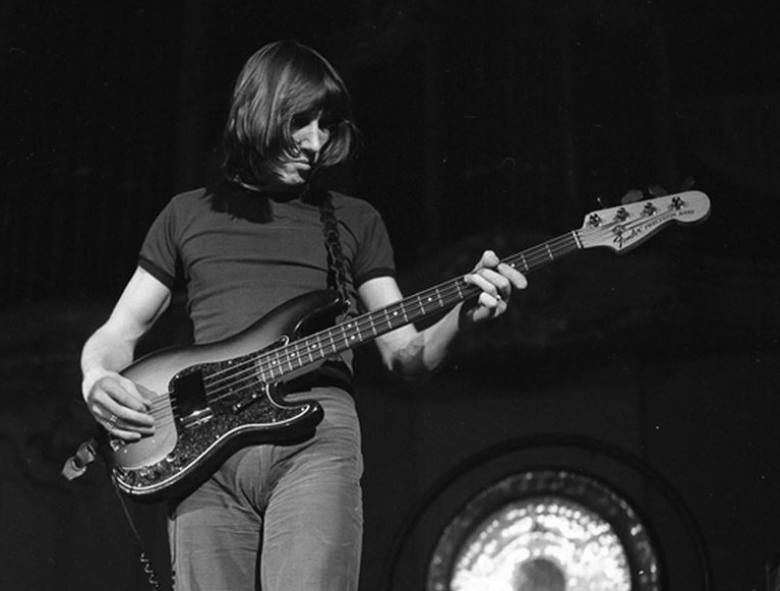
Roger Waters playing his Precision in 1971
In 1954 the Stratocaster guitar came out with its innovative, more rounded body contours, and this carried over to the Precision too; in 1957 the design changed even further, resulting in the Precision that became famous and has remained largely unchanged to this day: the pickup became a split design (one segment for strings 1 and 2, another for strings 3 and 4, slightly offset from each other so all the tones stayed more balanced and hum cancelled out), the headstock became more Stratocaster-like, and the pickguard also came to resemble the Strat’s more closely, incorporating the controls and the front-mounted jack output as well.
In 1959, just as with the Strat, the one-piece maple neck was replaced with one featuring a separate, glued-on fingerboard, either rosewood or maple. The scale length (the length of the strings from bridge to nut) was 34 inches (with 20 frets), which has become the standard for electric basses, although today it’s also referred to as “long scale”, since shorter-scale basses came along later. More recently, versions with the same scale length but 22 frets have also been made.
The Precision’s sound is deep and punchy but relatively smooth, dominated by the fundamental note with few harmonics — highly consistent, but not very versatile, since with a single pickup and just one tone control there wasn’t much room to play with sonically.
In 1970 Fender offered a Fretless version for the first time, which wasn’t successful in its early years, and in 1999 a 5-string version. The Precision has remained enormously successful right up to today.
Among classic Prog bassists who had the Precision as their bass of choice are Roger Waters of Pink Floyd, John Wetton of King Crimson, UK, Asia, etc., Mike Oldfield (whenever he played bass), and John Deacon of Queen, with many others also using it alongside basses from other models or manufacturers. John Wetton frequently used a white Precision from which he’d removed the pickguard, keeping only a small plate for the volume and tone controls and the jack output (Roger Waters also had one without a pickguard in Pink Floyd’s early years).
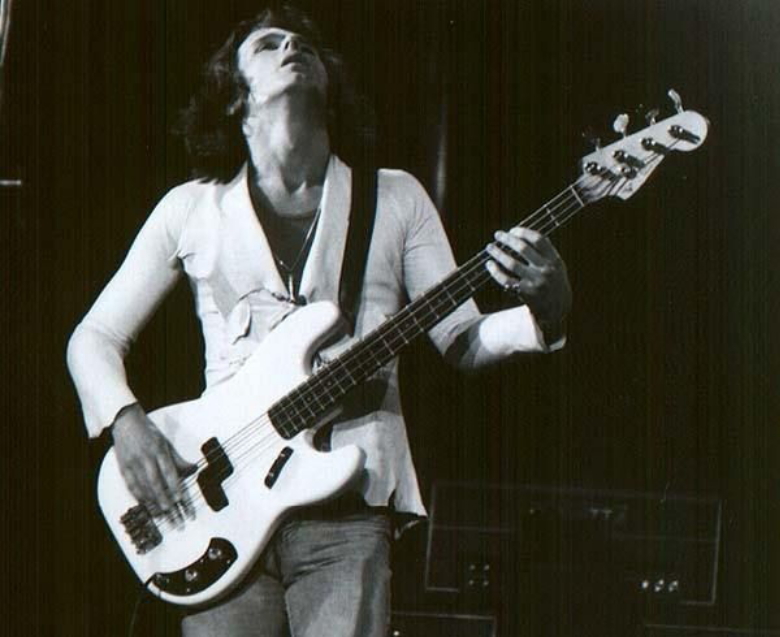
John Wetton with his white Precision, no pickguard. In case you’re curious about the small elongated piece fixed to the body below the strings, it’s called a tug bar, and it offers finger support depending on the technique being used. When it’s positioned above the strings, it’s called a thumb rest
Fender’s other hugely successful bass is the Jazz Bass, launched in 1960 and shortened to the “J-bass”. The main differences from the Precision are its slightly narrower, more rounded-profile neck, which many musicians found easier to play, a body with a slightly different shape for more comfortable seated playing, and the use of 2 single-coil pickups, positioned at the middle and the bridge. It has 3 potentiometer controls, one volume for each pickup plus a master tone, mounted on a small metal plate separate from the plastic pickguard.
Its sound is brighter and higher-pitched than the Precision’s, with more mid and high-frequency harmonics, and having 2 pickups gives it considerably more tonal versatility. It’s therefore also better suited to more modern techniques like slapping or popping, which emphasise the brighter tones.
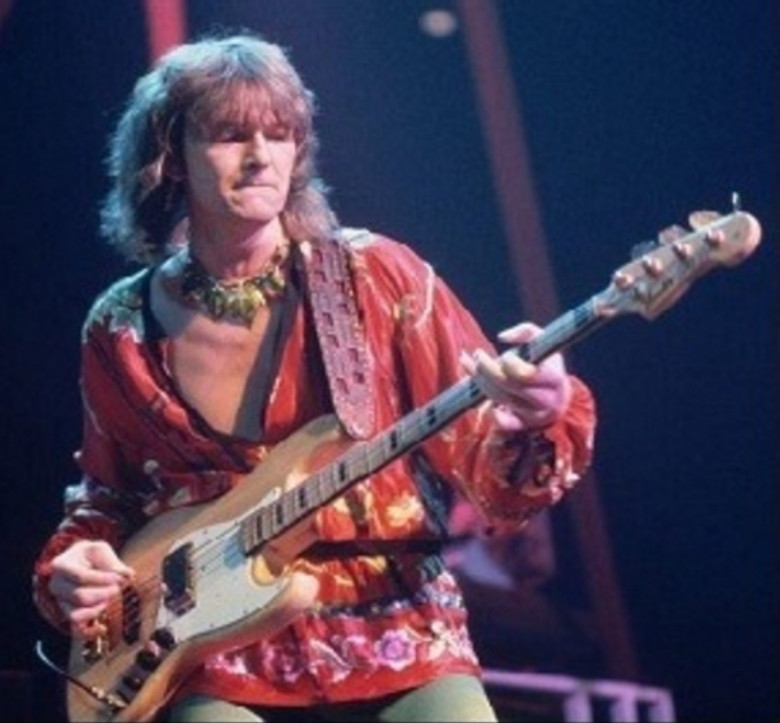
Chris Squire playing a Jazz Bass
One particularly famous Jazz Bass was Jaco Pastorius of Weather Report’s, from which he removed the frets around 1970 and popularised the fretless approach (though the first commercial fretless bass was actually the Ampeg AUB-1 from 1966). Pastorius also removed the pickguard, leaving only the small metal plate for the volume and tone controls and the jack output.
Other bassists who have used the Jazz Bass to a greater or lesser extent include John Paul Jones of Led Zeppelin, Chris Squire of Yes, Greg Lake of ELP, or Geddy Lee of Rush.
Fretless and 5-string versions were also released, along with versions with a 22-fret neck. Today there are also some versions of the Precision with 2 pickups: the standard split one in the middle, and a Jazz Bass pickup at the bridge.

Geddy Lee playing a Jazz Bass
Two other Fender basses that weren’t especially successful at the time but are historically important are the 6-string Fender Bass VI, launched in 1961, and the 5-string Bass V, launched in 1965, which, despite what their names might suggest, didn’t have all that much in common.
The Bass VI (originally just called the Fender VI) was a kind of hybrid between a bass and a guitar, and visually it resembled a baritone guitar more than a bass. Baritone guitars have a longer neck, with a scale length of around 27 inches (compared to the standard guitar scale of around 25 inches); they use guitar-type strings but are tuned differently, usually a fourth lower than a guitar. The Bass VI had a short-scale bass length (30 inches), bass strings and tuning, but otherwise it looked more closely related to the Fender Jaguar guitar than to a 4-string bass — it even had a tremolo-bar bridge, something highly unusual for a bass (it wasn’t the first 6-string bass, though — Danelectro had already released a similar one back in 1956).
The Bass V, for its part, was indeed the first 5-string bass, though it wasn’t successful and was discontinued in 1971. 5-string basses did go on to gain popularity from the ’80s onward, and are very common today. The Bass V differed from modern 5-string basses in that the 5th string was added to the usual 4 to extend the range upward, whereas the typical modern approach is the opposite — the 5th string adds lower notes.
Fender has also built other bass models, such as the Telecaster Bass, the Mustang Bass or the Jaguar Bass, but none of them has matched the success of the Precision and the Jazz.
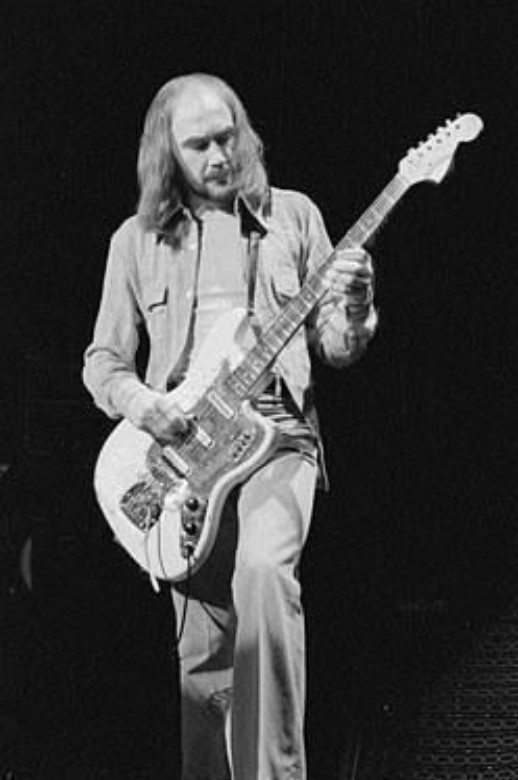
Roy Babbington of Soft Machine playing a Fender Bass VI
Until next time!
Gerard Bassols
If you enjoy this topic, remember you’ll find much more information in the book “Los Instrumentos Musicales del Rock Progresivo; Guía Ilustrada”, available at this link. Have you read the readers’ reviews yet?
https://www.amazon.es/instrumentos-musicales-Rock-Progresivo-ilustrada/dp/8413318645
And if you’d prefer, it’s also published in English:
https://www.amazon.com/Musical-Instruments-Progressive-Rock/dp/8413385997