
Progressive RockJazz

Art Against Agony is an artist collective that started out as an instrumental jazz and progressive-metal band in Stuttgart back in 2012. Beyond music, their work also includes photographic and video art, and live performances. Every member of the project uses a pseudonym to hide their real name, and a mask to cover their face. Wow, so original!
This time they present us with 94 minutes of polymorphic, labyrinthine music, demanding for any listener. So buckle up, because it will not be easy — but overall you will get to enjoy an interesting, intense piece of work.
Densely, forcefully and rhythmically, we plunge into “Sounds of Inetability”, the track that gives this record its title. This brief introduction unfolds in a restless atmosphere. It is followed by “Slightly Ov”, with equally unsettling opening territory that provides the ideal breeding ground for the later development of several riffs and rhythmic figures very much in the style of Watchtower, where the language of progressive metal explodes in full force.
A gentle opening leads us toward ideas with a certain exoticism, especially emphasised by the use of percussion emulating a kind of Indian tabla on “She Who Thirsts”, where the guitar melodies are forcefully backed by the rest of the band. The work put into creating contrasts between loud and soft passages is quite notable. Even so, the rawness of the playing never lets it lose intensity.
The amusing “At the Djentist” takes us to the dentist’s office — they even include the sound of a dental drill. The complexity of the composition, mixing together a chain of melodies, rhythms and different instruments taking the spotlight, gives it an almost eccentric, obsessive character that makes it an almost mandatory listen. As with the previous track, this band’s musical vocabulary is very broad, since we find modern-jazz stylistic turns on the guitars, progressive-rock ones in the rhythm section, and the aforementioned power.
And the subtlety they show in the opening bars of “Honey Cake Whorse” reinforces their argument. This track, progressively (it’s what prog does), offers us a kind of histrionic ballad, where a piano appears in the middle section, experimenting with a dissonant melody that the guitar will answer, backed by the rest of the instruments. This complex fusion is rich in musical-language diversity, showing that these gentlemen have had serious training.

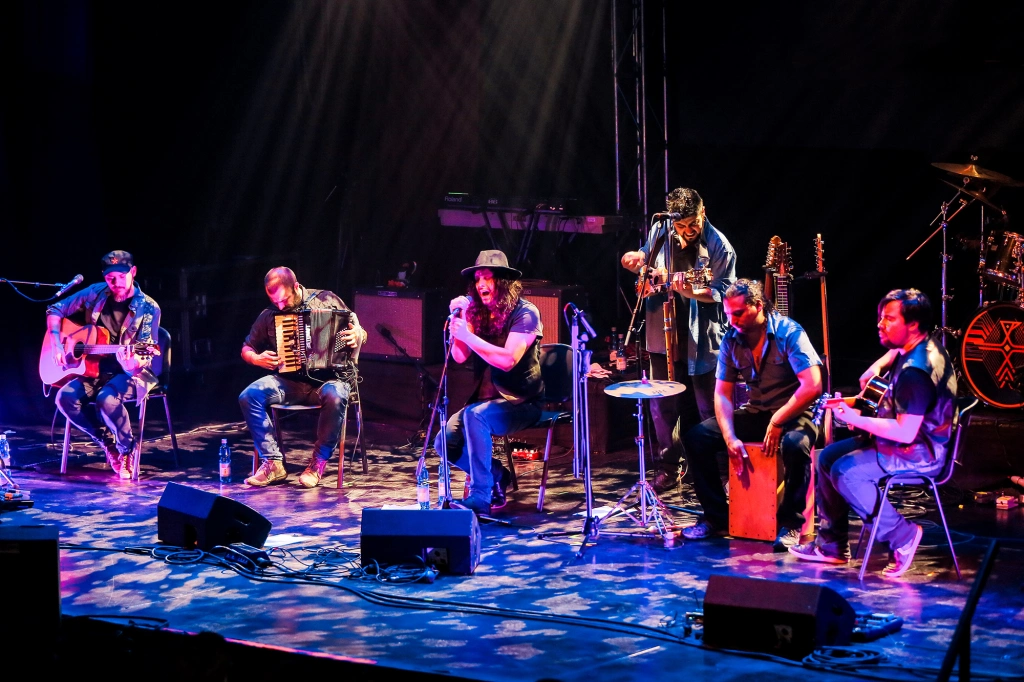
The lovely melodies built on Arabic scales draw us into the relaxed “Únete a mi ser”. Here the harmonisations serve the vocals, which act as the track’s connecting thread. The opening melodies are interwoven, with a solo added at the end to close the track out.
Even more melancholic and unhurried is “Regreso”. In a gentle 3/4 metre, the story unfolds until the arrival of the interlude, where the roots they are championing move to the foreground with the familiar sounds of charangos and quenas. The same goes for “Caracol”, though it explores ideas much closer to rock, drawing on that same fusion between these two worlds.
The use of a looped keyboard and an electronic drum machine on “Squirrel 6a6ʜИK edit” temporarily shifts the direction the album had taken, opening a section where electronic instruments take the lead. These different sounds give our ears a bit of variety, but the result falls short of anything standout. “Salience Bias”, the next track, confirms what has just been said, with the peculiarity that, being more ambient, it has a pleasantly subtle edge, despite being a touch repetitive.
And we might have said much the same about “Hindsight Bias”, were it not for the guitar’s fully jazz-rooted ideas, which would delight Allan Holdsworth, and for the delicate flute of Aralee Dorough (it seems the whole anonymity thing does not apply to her), who, despite being known as a classical-music performer, shows here that she has an enormous musical vocabulary. If we had to point out one flaw, it is the use of digital drums when real acoustic ones would have suited it better. To close, we head straight into a final section exploring the principles of progressive rock.
Another shift comes with “Fitches Brew”, which carries a certain tonal, almost intentional resemblance to Miles Davis’s famous “Bitches Brew”, though again within a progressive-metal framework, with few real similarities. So: either it is some kind of tribute, or our imagination is running away with us (more than usual) in this review, and it is pure coincidence.
On “9” Smack”, we get a track with intricate rhythmic execution and powerful riffs, but with barely any melody — which is not a bad thing when the composition is as interesting and engaging as this one. And with a fairly similar concept, “Orange” unfolds, though with more dynamism and complexity, and a middle section reminiscent of the legendary King Crimson’s later studio work.
The next two tracks, “His Daughter’s Eyes, Pt I” and “His Daughter’s Eyes, Pt II”, again feature Aralee Dorough, presenting two fairly experimental pieces built around more classic prog ideas, with touches of Baroque fugue, a bit of jazz, and plenty of metal. In the second part, a couple of spoken passages are layered in the background while they keep spinning out ideas that lead into several guitar and flute solos, bringing back the main motif multiple times across the whole composition. Quite something!
And three more tracks sharing the same title: “Alteration, Iteration, Alliteration, Pt I”, “Alteration, Iteration, Alliteration, Pt II”, “Alteration, Iteration, Alliteration, Pt III”. And all three attempt the three actions in the title: they alter structures, time signatures and harmonies; they repeat forms recurrently; and they reiterate the same sounds and figures. It is impressive when a band sets out to run a musical experiment and pulls it off; whether you like the result more or less afterwards is down to taste, but technically it is flawless. The third part is certainly the most melodic, though it is basically still a very rhythmic experiment.
With the amusing name “Indo-German Cuisine”, they fuse the sounds of Indian percussion elements with the most forceful progressive-metal arrangements. Perhaps because we have spent so many minutes already exploring the same ideas, this one can feel a bit hard to digest, much like certain Indian dishes we are not used to.
So when we hear the bright, simple chords of the guitar on “The_Island & The_Exception”, it is genuinely welcome. Though only the chords are simple, since the rest of the instrumentation is deep and almost unfathomable. Honestly, this must be a band that absolutely floors you live, provided you approach them with an open mind.
This is probably the kind of album we will listen to once or twice every five years and, given its length, perhaps rarely start to finish. It is fantastic, but not historic. For those who occasionally flirt with eccentric music, this one is well worth an ear.
Writer: David Sàez