
Alternative

This review led me down a few rabbit holes of reflection that I’m going to share, so brace yourselves for a lecture even Roger Waters himself couldn’t out-ramble. But since I’m more considerate than grandpa Roger, here’s the short version in case you’d rather skip my musings: if you like Muse, go listen to some tracks by this band.
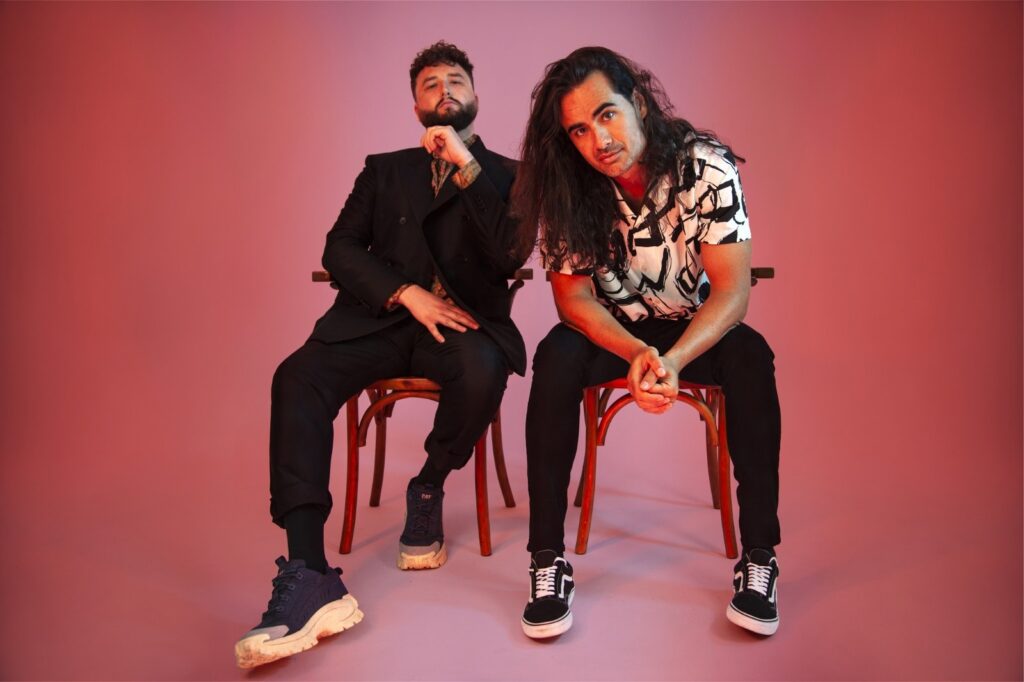
Who are Dear Sherlock? Well, it turns out that over 10 years ago, a musician from Kingston upon Hull (Hull, to friends), Jamie Gray, happened to come across the Portuguese band Reckless, which featured Eduardo Lemos. After swapping notes on social media, they started sharing their music too. They then decided to compose together, one from Hull and the other from Porto, always with the collaboration of Portuguese drummer Daniel Carvalho. This gave birth to the EP “Dear Sherlock” (2012).
They become a small cult act of sorts, a kind of “deep-web underground”, gathering scattered followers and fans around the planet. But the distance leaves the project on hold, aside from the occasional show the two friends played whenever their holidays lined up. Until 2017, when they released the single “Da Vinci’s Chamber”, followed in 2019 by their second EP, titled, in a real exercise of originality, “II”.
We’d guess the Covid-19 pandemic must have put the project on ice. But this year they’ve finally delivered their first album: “Object of Ridicule”.
And what happens? You can tell it’s not the work of a band but of two musicians living more than 2,000 kilometres apart, composing and working via FTP-based apps — not that we’ll name commercial services like Dropbox or WeTransfer or similar, since they’re not paying us to mention them.
That’s just how our world works nowadays. What you gain, on one hand, by being able to work with your musical soulmate, you lose, on the other, in a creative process that isn’t in sync. Personally, I work both ways as a musician, and the final result is almost always more successful the “traditional” way.
The album opens with the track “Intro”, which, as you can probably guess from the name, is a minute-and-a-half ambient keyboard-and-effects piece. And once we’re set up, “Les Enfants” kicks off with powerful riffs and an opening verse that makes this whole record’s reference point, or influence, immediately obvious, since it could easily have been signed off by Muse themselves on a particularly rocking day. More than a song, it’s like a second introductory track, especially obvious given its lack of conventional structure, closing with a run of effects for an unsettling feel.
We continue with “XPTO”, with gorgeous vocal lines, and, like the previous track, excessive saturation in the mid frequencies that must come from over-compression. So whatever dynamism the track has comes from layering instruments in and out, rather than through the playing itself, which stays consistently linear — much like Devin Townsend’s work.
And again, as before, we get an unsettling keyboard atmosphere leading us into “Tracatu”. It’s worth saying that up to this point you get the feeling of listening to a rock opera set to a Roger Corman film, very much in keeping with the album cover. The track itself starts showing some problems: everything is starting to sound the same, and the compositions suffer from compromised guitar choices that form the tracks’ foundation: the same kind of riffs, “solos” that just scratch out chords like a mandolin or a dog scratching its itchy ear, the same saturation in the sound. On top of that, we get vocals always doubled, the same backing-vocal style, the same unsettling endings, and the same dramatic transitions between tracks built on classical-sounding atmospheres.
So when we reach “Bluecat” and I have to tell you the exact same thing again, that means something’s wrong. Even so, these are good, pleasant songs to listen to — but they all sound the same, because they’re the same thing over and over. And that’s exactly what I’m telling you right now.
And here we could reflect once more on how this record was put together. Because band compositions, built on the spot together, always end up adding creative ideas that come from improvisation, or from perspectives that form organically. If you play a team sport, are a musician yourself, or don’t work alone, it’ll be easier to grasp the idea I’m trying to get across.
So this kind of project works better as singles or EPs, where the creative limitations that come with composing by correspondence can dissolve if the work is offered in short pieces, spaced further apart in time.
“Interlude I: Object of Ridicule” is another ambient transitional track into a “new” song, “Slashed”. Though here we do get something new: in the first third there’s a passage that does seem to show some band dynamics, playing the track at a lower volume — though in reality it was played the same way throughout and the volume was simply pulled down in the mix. The structure repeats a second time, flowing into the first proper guitar solo, which leads us to a conclusion.
“Interlude II: Fundamental Opposition” is another ambient transitional track into a “new” song, “Diaphragm”. Regardless of the production falling into the same tricks, we can say the 3/4 rhythm gives it a different cadence from what we’d been hearing, though we’re back to the stylistic trick of lowering the volume mid-track, leading into an abrupt ending.
“Interlude III: Self-Evident” is another ambient transitional track into a “new” song, “Don Pablo”. It’s a relief that, since it’s all so similar, you can just copy and paste in this review, and it even reinforces the sense of repetitiveness, with someone perhaps thinking: “What a brilliant literary device this titan of Catalan letters is using”. Who knows, maybe I’ll fool someone.
But let’s talk about “Don Pablo”. This time Muse have woken up and put on some Green Day. That said, the vocal interlude carries a noteworthy Queen flavour that genuinely surprises you. And the funniest part is the closing solo sounds like Brian May himself dropped by to play with the Muse-doing-Green-Day lineup. A curious, pleasant second half to the track.
The next track opens with something different, something the album has needed for a while now. The start of “Geometric Unity”, with an acoustic guitar and thoroughly pop production, followed by unsettling backing vocals, gives the record what it was so badly missing: variety. Even so, the track’s second half falls back into the usual clichés.
“Flux” has a riff that strongly reminded me of Nirvana’s “Bloom”. And the problem is that all it made me want to do was switch over to listening to Nirvana’s “Bloom” instead. You know how it goes, rejecting the imitation for the real thing. The chorus, admittedly, is nothing like it, since it’s just like all the other tracks I’ve already talked about.
The nearly two-minute instrumental opening of “Clarett” is, I’d guess, another attempt to offer something different. Beyond the usual vocal lines, it’s worth noting a taste for classical language in the piano and keyboard arrangements, inspired by Romantic composers like Franz Liszt or Frédéric Chopin. The foundations and the musical language are undeniably there.
And when you listen to “Blackhole” you have to wonder: “Do you really need to make 59 minutes of music, when with 35 or 40 you’d have more than enough material, and it wouldn’t be so obvious your creativity keeps circling the same ideas?” It’s almost like shooting yourself in the foot. I’ll bring back my earlier point: these projects work better as singles than as full albums.
We close the listen with “Nomophobian”. An arpeggiated introduction with a strong Romantic-classicist influence gives way to a crescendo leading us into another mandolin-style solo, the kind post-rock fans love so much. Once again, the composition’s solid musical foundation is more than evident, and the performers’ classical training clearly shines through. And, what can I say, this track turns out to be genuinely fascinating to listen to, since it also gives us an ending very much in the style of Vangelis.
Writer: David Sàez