
I’m Gerard Bassols, and with this article I’m starting a series looking back at some of the most iconic musical instruments frequently used in Progressive Rock, especially during its classic period in the 1970s. These articles can be seen as short extracts from the book “Los Instrumentos Musicales del Rock Progresivo; Guía Ilustrada” (“The Musical Instruments of Progressive Rock: An Illustrated Guide”), where you’ll find much more detail, and which I’ve linked below. I’ll start with what is probably the most paradigmatic instrument of the ’70s Symphonic Rock sound: the Mellotron.
The Mellotron has a long and fascinating history, so I’ll be dedicating more than one entry to it — this one today is the first. We can’t talk about the Mellotron without mentioning its direct predecessor, the Chamberlin; in fact, the Mellotron was born as an illegal copy of the Chamberlin.
The Chamberlin was developed starting in 1948 by Harry Chamberlin in the USA, and it was the first “rompler” — a musical instrument that plays back sounds from recorded or encoded samples, either analogue or digital (a sampler, unlike a rompler, can also record or encode its own samples). In this case, the samples were recordings of real instruments on magnetic tape. The first Model 100 was very basic, and didn’t even have a keyboard — just a series of tapes with backing-track recordings the user could play along with to practise melodies or solos over them.
After a few other models, in 1962 Chamberlin released the Model 600, which would become the basis for the first Mellotron. It had two manuals (keyboard sections): the left for backing accompaniment, the right for melodies or solos. On the right-hand manual, pressing a key played back a magnetic tape with the sound of that note performed on a real instrument. It let you choose between the sound of various instruments, including keyboards, strings, some brass and woodwind, and notes sung by human voices.
The Chamberlin enjoyed some popularity in the USA until the mid-to-late 1960s, but later on it was the Mellotron that achieved fame, and the Chamberlin was unfairly forgotten or remained unknown to most people, especially in Europe.

The Chamberlin Model 600
That same year, 1962, a Chamberlin salesman named Bill Fransen went to Europe carrying two units of the Model 600, without telling Mr Chamberlin. In the UK, he found the Bradley brothers’ firm Bradmatic and told them the instrument was his own invention; the two parties struck a deal to manufacture it commercially. The Bradleys had no idea the Chamberlin already existed in the USA, and so in 1963 the Mellotron Mk I was born — a copy of the Chamberlin 600 with a few minor tweaks — which they took to the NAMM trade show (National Association of Music Merchants) in Anaheim, California. There, Harry Chamberlin was shocked to see a copy of his own instrument on Bradmatic’s stand. Chamberlin spoke with the Bradleys, and they quickly realised what had happened with Fransen’s deception; and since it was clear the Mellotron infringed on Chamberlin’s patents, they reached an agreement: the Bradleys would pay Chamberlin a significant sum in royalties, and until the late 1960s the Mellotron could only be sold in Europe, while the Chamberlin would be sold in the USA and the rest of the world.

The Mellotron Mk I
The Bradleys soon set up two new companies for the Mellotron business: the commercial arm was called Mellotronics, and the production arm Streetly Electronics, and they released the Mk II model, practically identical to the Mk I with minor improvements. In 1967 the Beatles used a Mk II on their hugely successful single “Strawberry Fields Forever”, which brought the instrument to fame. Mike Pinder, keyboardist of the Moody Blues, who had worked for Streetly, also used the instrument on classic albums like “Days of Future Passed”, also from 1967.
In 1969, King Crimson used it sublimely on their debut album, “In the Court of the Crimson King”, with its abundant string arrangements and human-voice choirs, which established the paradigmatic Symphonic Rock sound that would flourish over the following years. Keyboardists in other Symphonic and Progressive Rock bands, such as Rick Wakeman or Tony Banks, soon also adopted the Mellotron as a standout instrument in their setups.
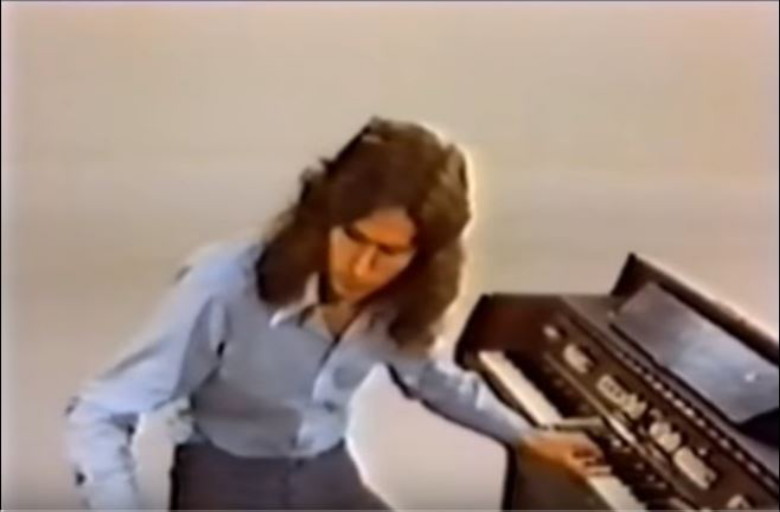
Tony Banks playing a Mellotron Mk II with Genesis in 1972
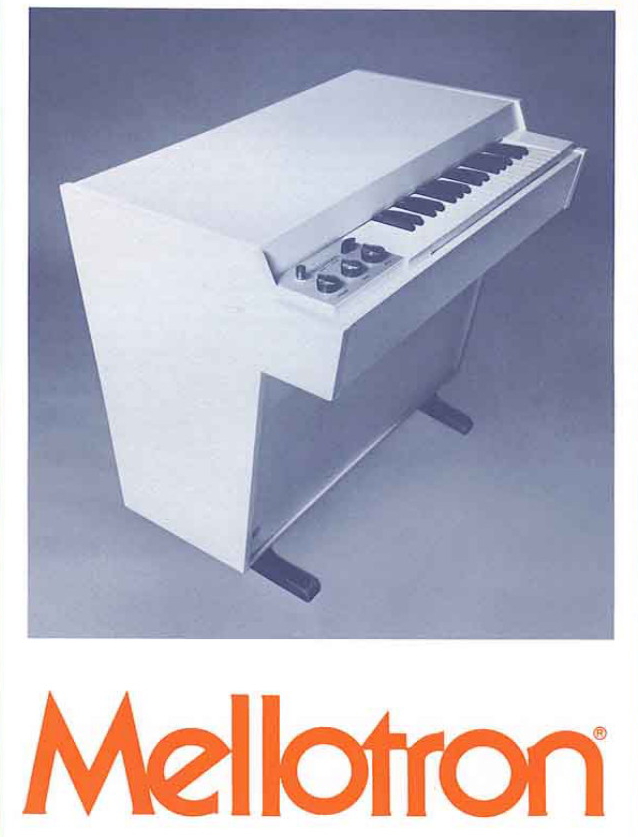
The Mellotron M400
Like the Chamberlins, the first Mellotrons were designed for static use in private homes or recording studios; they were heavy and very delicate. Realising that rock bands needed a portable instrument to take on tour, in 1970 the Bradleys released the M400 model, which was much more compact and lightweight, and would go on to become the most famous and most widely used by bands throughout the ’70s. Even so, it remained a delicate, unreliable instrument — bands who could afford it took two units on tour, so they always had a backup, and they’d be repaired and adjusted constantly after every show.
Rick Wakeman got so fed up with the Mellotron’s unreliability that, as soon as he was able to start using other, more modern instruments like the Birotron prototype or the RMI Keyboard Computer, he took two of his Mellotrons out to a field, doused them in petrol, and set them on fire.
Because of the magnetic-tape playback system, which had to rewind to the starting point before it could be played again, the Mellotron had a slow action, and couldn’t handle overly fast note passages, but it was ideal for slow, sustained sounds like strings or choirs. And a great thing about it was that it was fully polyphonic, unlike the synthesizers of the time, which were monophonic.
Among the great ’70s Progressive Rock acts, almost every keyboardist had a Mellotron in their setup, but there are a few notable exceptions. Keith Emerson never liked the instrument, because you couldn’t play it fast. It was tried out on the “Trilogy” album tour in 1972, for the song “Abaddon’s Bolero” (played by Greg Lake), but due to problems they soon decided to drop the track from the setlist, and ELP never used a Mellotron again. Pink Floyd’s Rick Wright wasn’t a fan of the instrument either — he used a Mk II on a few studio tracks up until 1970, but never took one on the road, and from then on focused on piano, acoustic or electric, organs and synthesizers.
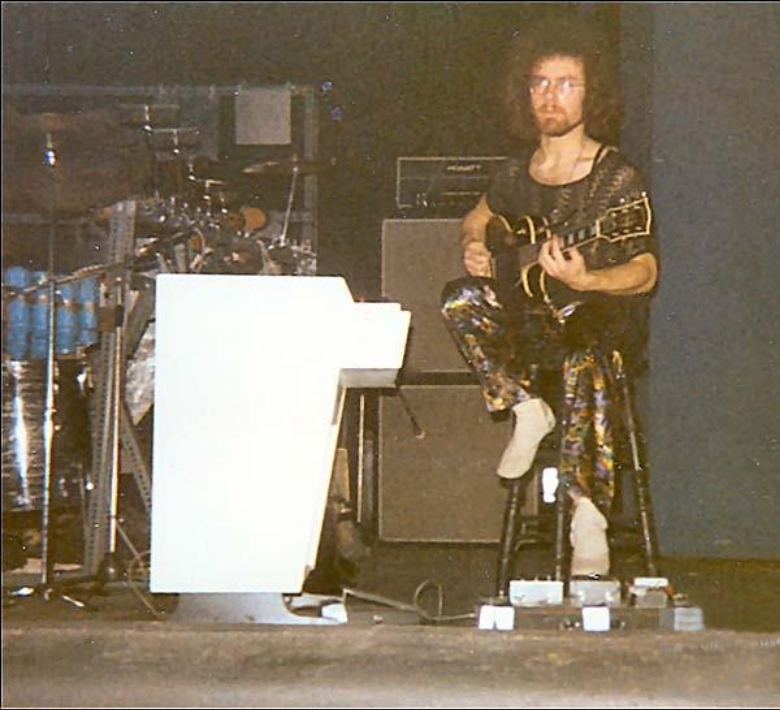
Robert Fripp with a Mellotron M400
In the next entry in this series, I’ll talk a little more about this paradigmatic instrument. Until then!
Gerard Bassols
If you enjoy this topic, remember you’ll find much more information in the book “Los Instrumentos Musicales del Rock Progresivo; Guía Ilustrada”, available at this link:
https://www.amazon.es/instrumentos-musicales-Rock-Progresivo-ilustrada/dp/8413318645